

 Location:
The 5th Global Teacher Education Summit (GTES), hosted by the Center for Teacher Education Research at Beijing Normal University (CTER-BNU) – a Key Research Institute of Humanities and Social Sciences at Universities under the Ministry of Education – was held from October 25th to 28th, 2024 at BNU. Under the theme "Building a Global Teacher Education Community for Future Possibilities," the summit brought together 25 renowned experts and scholars from 20 countries and regions, including Mainland China, Taiwan (China), Hong Kong (China), Macao (China), Japan, Singapore, the United States, Canada, the United Kingdom, Greece, Brazil, Portugal, Australia, and Israel. Additionally, over 600 domestic scholars from 523 universities (including 10 from Hong Kong, Macao, and Taiwan) participated in the event.
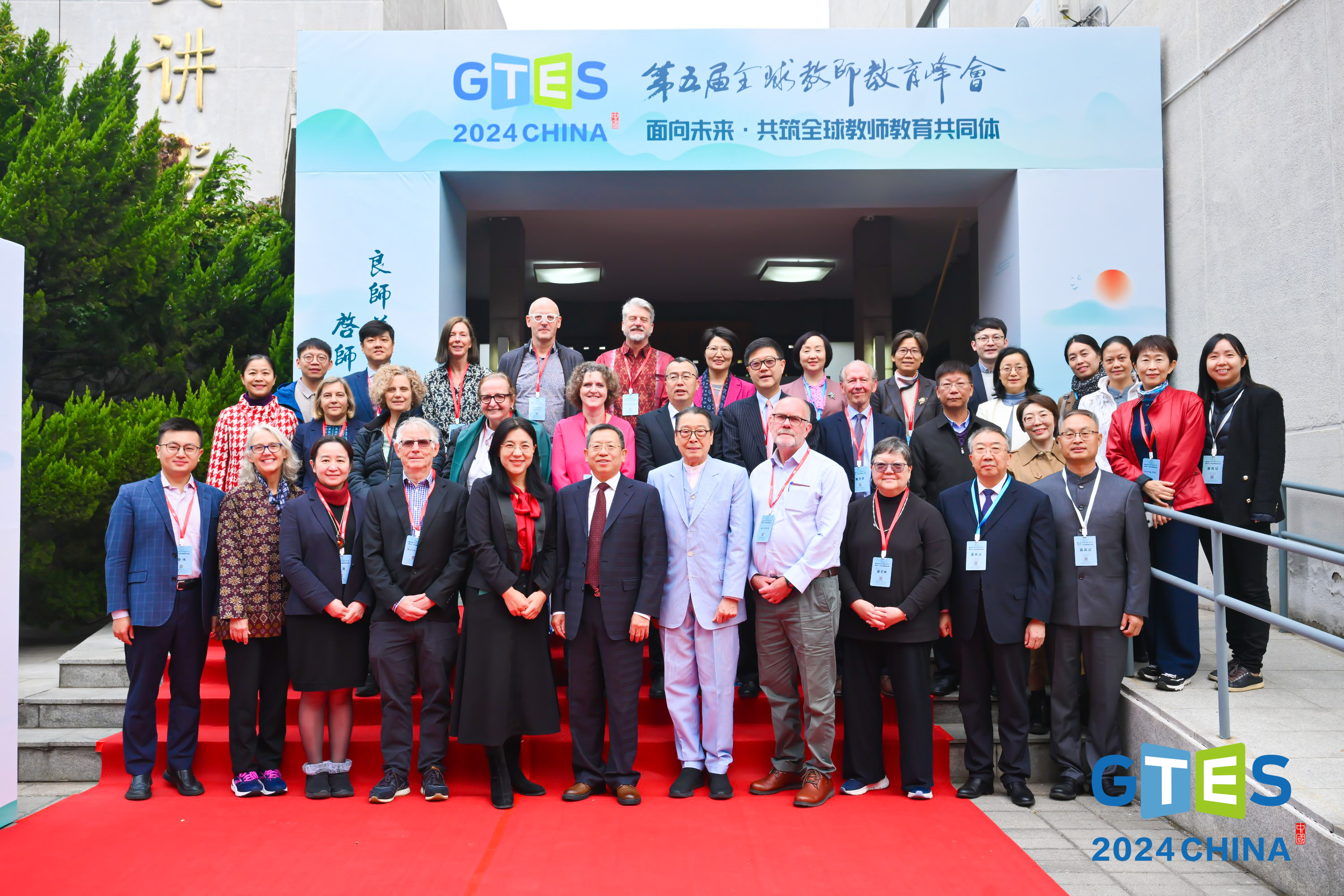
The summit featured five thematic areas of focus, facilitating in-depth discussions on topics such as cultivating key teacher competencies in the post-pandemic era, the impact of digital technology on teacher learning, innovations in subject-specific teacher education theory and practice, curriculum reform in basic education and its implications for teacher education change, and cross-boundary collaboration for innovation. Leading scholars in global teacher education research engaged in various formats, including keynote speeches, invited talks, panel symposia, parallel paper presentations, roundtable discussions, and poster sessions. The program included 26 main session reports (comprising 10 keynote speeches, 8 plenary invited talks, 5 invited talks, and 3 Tin Ka Ping Lectures), 29 panel symposia, 36 parallel paper sessions, and over 100 poster presentations, totaling 510 research presentations.
The opening ceremony took place on the morning of October 26th at BNU's Jingwen Lecture Hall. In her address, Zhao Jing, Director of the Division of Teacher Education of the Ministry of Education, noted that teacher education is a core element for building a strong education system and achieving modernization. She called for enhancing teacher education quality through strengthened faculty, educational reform, research innovation, and international cooperation to support the national strategy for education power. Kang Zhen, Vice President of BNU, emphasized the new opportunities and challenges for teacher education and workforce development amidst trends like technological advancement, globalization, and personalized teaching, expressing a desire to strengthen collaboration with domestic and international universities and institutions. Zhu Xudong, Director of the Center for Teacher Education Research at BNU, noted that the summit coincided with the center's 20th anniversary, highlighting the center's achievements, its alignment with global teacher education development, and its synergy with China's teacher education progress. He invited all participants to engage in global dialogue and share wisdom to boost innovation in teacher education. The ceremony was hosted by Shi Kecan, Party Secretary of the Faculty of Education at BNU.
Distinguished speakers delivered insightful keynote and invited reports. Professor Leslie N.K. Lo, Distinguished Senior Chair Professor at BNU’s Faculty of Education, analyzed the challenges and opportunities for a global reconnection of teachers and teacher education, focusing on learning loss, demographic shifts, lack of international collaboration, and the impact of AI. Professor Day from the University of Nottingham discussed the importance of teacher professionalism and the need for a "culture of curiosity." Professor John Chi-kin Lee from The Education University of Hong Kong deconstructed teacher core competencies from Eastern and Western philosophical perspectives, integrating Confucian thought. Professor Lynn Paine from Michigan State University analyzed three dilemmas facing teacher education, arguing for a dynamic, future-oriented process. Professor Cai Chun from Capital Normal University explored Generative AI's impact on teacher education based on Popper's Three Worlds theory.
Parallel forum highlights included presentations on teacher adaptive expertise by Amanda Berry from RMIT University, collaborative curriculum design by Gillian Roehrig from the University of Minnesota, the role of educational science by Carlota Boto from the University of Sao Paulo, and a framework for language teacher expertise by Jiebing Li from Nanyang Technological University. Other keynotes and invited talks featured global experts such as Li Jun from Western University (Canada) on the Chinese model of teacher education, Maria Assunção Flores from the University of Minho (Portugal) on rethinking teacher education in uncertain times, David Kirk from the University of Strathclyde (UK) on adaptive capacity, Despina Potari from the University of Athens (Greece) on teacher collaboration, and Christophe Ronveaux from the University of Geneva (Switzerland) on using picture books as pedagogical tools.
An "AI-Enabled Teacher Education Roundtable Forum" featured dialogue between experts from the tech industry and the education sector. Andreas Schleicher, Director for Education and Skills at the OECD, delivered a virtual speech using PISA data to discuss teacher motivation, digital and AI readiness, and the importance of professional collaboration. Martin Mills, Editor-in-Chief of Teachers and Teaching Theory and Practice from QUT, spoke on the continuing relevance of teacher professionalism. Professor Wenlin Ge (William) from Boston College called for a paradigm shift from 'improvement' to 'transformation' in teacher education. Professor Qing Gu from UCL emphasized the importance of school organizational environment for teacher retention. Professor Yasushi Maruyama from Hiroshima University explored the possibility of a global teacher education community based on professionalism, ethical aesthetics, and community of practice. Li Qiong, Executive Deputy Director of BNU's Center for Teacher Education Research, presented empirical research comparing the teaching competence of government-funded normal students versus graduates of top comprehensive universities.
In his closing report, Song Huan, Secretary-General of the conference committee, noted a record 510 submissions, including first-time submissions from neuroscience perspectives, and participation from new countries like Greece, Portugal, Brazil, and Israel. In his closing address, Zhu Xudong announced that the summit may shift from a triennial to a biennial event, potentially expanding to other cities like Shanghai, Hangzhou, Chengdu, and Chongqing. He stated that the summit has evolved from focusing on advancing China's teacher education to serving as a vital platform for promoting global teacher education development. As a highly significant academic event in the field of global teacher education, the GTES summit continues to inject dynamic energy into pooling global wisdom, deepening international cooperation, and promoting the high-quality development of teacher education.


