
 Location:
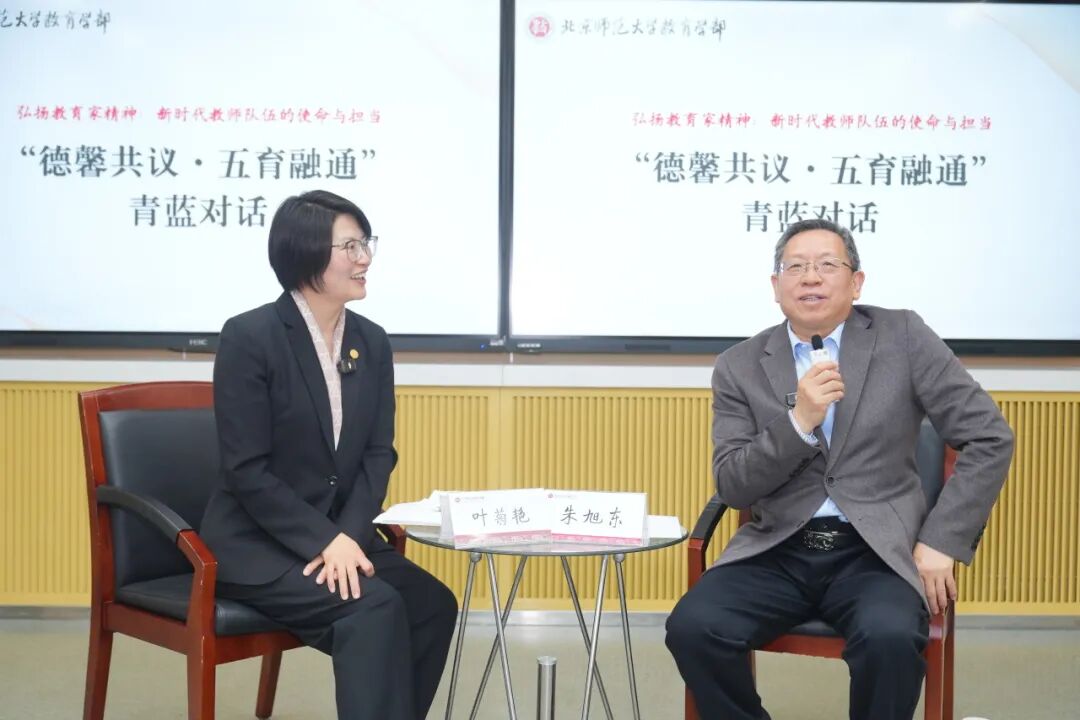
In April, during The Green-Bamboo Dialogue: An Academic Intergenerational Exchange at the Faculty of Education Academic Culture Festival, two scholars from CTER—Professor Zhu Xudong and Associate Professor Ye Juyan—engaged in an exchange that combined academic depth with practical concerns on the topic of "The Spirit of Educators and Teacher Development." As an academic inheritance spanning over a decade of mentor-student relationship, the words "Green-Bamboo" (青蓝) not only symbolize quiet perseverance but also represent innovative vitality. This article, based on the dialogue content and combined with Professor Zhu Xudong's relevant theoretical discussions, takes the Spirit of Educators as the central theme, organizing and presenting the core perspectives on the Spirit of Educators and teacher development , to the interpretation of connotation, and finally to the pathways for teacher development.
Contemporary Positioning of the Spirit of Educators: A Beacon and National Narrative
In his book Understanding the Spirit of Educators (《读懂教育家精神》), Zhu Xudong summarizes the positioning of the Spirit of Educators with a vivid metaphor—"teachers walking on the path of educators with a guiding light." Ye Juyan initiated the first question of this dialogue based on this metaphor: Why compare the Spirit of Educators to a "beacon"? What unique value does the Spirit of Educators hold in our contemporary era? Zhu Xudong pointed out that the current articulation of the Spirit of Educators has epoch-making significance. It serves not only as a lighthouse of individual teacher value but also as spiritual guidance at the national strategic level. It integrates personal professional growth into the grand narrative of national rejuvenation. From resisting external challenges to achieving the great rejuvenation of the Chinese nation, education undertakes an irreplaceable mission, and the Spirit of Educators is precisely the spiritual concretion of this mission within the teacher community.
The Spirit of Educators and Teacher Development: From "Relationship" to "Symbiosis"
After clarifying the contemporary positioning, Ye Juyan pushed the inquiry to the core: What is the relationship between the Spirit of Educators and teacher professional development? Is it a guiding relationship, or is it symbiotic? Zhu Xudong pointed out that the six core requirements of the Spirit of Educators—ideal and belief, moral character, wisdom in educating, dedication in practice, benevolence, and pursuit of truth—are essentially the connotations that teachers should possess in their development. Diligent study and dedicated practice constitute teachers' learning in their profession; loving education and caring for students form teachers' ethical foundation; enlightening wisdom and nurturing hearts represent teachers' educational wisdom. "The Spirit of Educators has symbolic meaning; it is the awareness that every teacher should possess and the spirit that should be practiced in their personal development process." The relationship between the Spirit of Educators and teacher development is not an external addition but an internal symbiotic relationship.
The Three Attributes of Teachers as Reflected by the Spirit of Educators
In the dialogue, Zhu Xudong systematically expounded the three attributes of teacher development, providing a complete logical framework for understanding the daily practice of the Spirit of Educators:
First Attribute: Professional Attribute. Teachers' professionalism distinguishes them from professions such as doctors and lawyers. Teachers face developing children, and this particularity determines that teachers must respond to educational issues in a professional manner. "Diligent study, dedicated practice, seeking truth, and innovation" within the Spirit of Educators is precisely the spiritual expression of the professional attribute. Teachers must continuously learn and research to accomplish their educational mission with professional confidence.
Second Attribute: Vocational Attribute. Zhu Xudong encouraged the students present that, while developing professionally, teachers should also assume responsibility for their career development, but this development "is not for oneself as an individual, but for this organization, for this discipline, for the development of national pedagogy." In this process, the Spirit of Educators can still play its role in value leadership.
Third Attribute: Holistic Person Attribute. Zhu Xudong particularly emphasized that teachers are first and foremost human beings—"their bodies must be healthy, their psyches must be healthy, and they must possess aesthetic appreciation." Teachers who truly practice the Spirit of Educators should be "harmonious teachers" who integrate all three attributes and excel in various aspects of life, work, and leisure. The three attributes of teacher development are indispensable; only through integration can one become a "harmonious teacher" with "high professionalism, high vocatality, and high holistic personhood."
Ye Juyan responded to this point: The three attributes are not isolated and parallel but dynamically interactive. "When teachers stand on the podium, all three are integrated and presented together." The harmony and conflict among the three attributes constitute the basic tension of teachers' daily professional life and are precisely the key arena where the Spirit of Educators plays its role.
Daily Practice of the Spirit of Educators: From the Narrative of Sages to Self-Awareness of Life
In response to the question of "How can the Spirit of Educators emerge," Zhu Xudong demonstrated a pragmatic posture of de-sublimation. He pointed out clearly that the Spirit of Educators is "summarized from teachers' practices and conferred as a symbolic meaning on the teacher community." Teachers need not "examine themselves three times a day," but should return to the professional state of their work and life itself. The core of the Spirit of Educators does not lie in deliberately pursuing sublimity but rather in the fact that "dedicated teaching itself is the embodiment of the Spirit of Educators." He used the "Three Teachings" theory within "teaching profession" (教导专业) to provide concrete pathways for this daily practice. "Teaching through the Body" (身之教) means every physical posture of teachers in the classroom has educational significance; "Teaching through Words" (言之教) reminds teachers that every word they speak will influence students; "Teaching through the Heart" (心之教) points to the deep spiritual interaction between teachers and students, including education of conscience and education of values. These three constitute a complete channel from the Spirit of Educators as a concept to its practice.
Value Adherence in the Era of Artificial Intelligence
In the closing of the dialogue, Ye Juyan directed the topic toward the cutting edge of the times: In the current era of rapid AI development, how can the Spirit of Educators strengthen teachers and forge their souls? Zhu Xudong pointed out that artificial intelligence is not a substitute for teachers but a magnifying glass and a touchstone. Teachers' irreplaceability is rooted in several core dimensions: emotional needs, critical thinking, and creative generation—these are what artificial intelligence cannot replace. He particularly emphasized the value of "originality": artificial intelligence is essentially based on integrating existing knowledge, while true creative capability remains uniquely human. The fundamental confidence for teachers facing the AI era lies in returning to the "underlying logic" of education. The educational wisdom and benevolence of the Spirit of Educators highlight their irreplaceable value: embodied education, emotional connection, value-based guidance, and creative generation constitute the fourfold defense line of teachers' core value in the AI era.
Conclusion: Educator Character with Roots, Light, and Soul
The entire dialogue centered on the core issues of the Spirit of Educators and teacher development, featuring both theoretical exposition and practical concern, demonstrating the deep reflection of pedagogical scholars on contemporary propositions. As Ye Juyan expressed in her closing message to the dialogue: May every education scholar cultivate educator character with roots, light, and soul in ordinary positions. These "three Haves" (三有) are precisely a summary of teacher development led by the Spirit of Educators: "With Roots" points to the deep rooting of professionalism and tradition; "With Light" points to the sense of direction and mission in the spiritual world; "With Soul" points to the irreplaceable life warmth and value steadfastness of educators.


